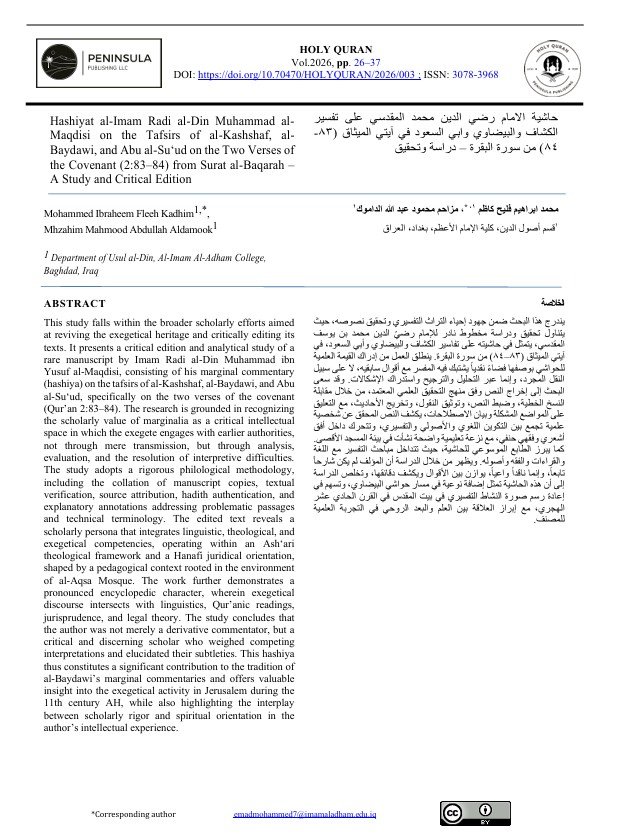
Hashiyat al-Imam Radi al-Din Muhammad al-Maqdisi on the Tafsirs of al-Kashshaf, al-Baydawi, and Abu al-Su‘ud on the Two Verses of the Covenant (2:83–84) from Surat al-Baqarah – A Study and Critical Edition
Article Sidebar
Main Article Content
Abstract
This study falls within the broader scholarly efforts aimed at reviving the exegetical heritage and critically editing its texts. It presents a critical edition and analytical study of a rare manuscript by Imam Radi al-Din Muhammad ibn Yusuf al-Maqdisi, consisting of his marginal commentary (hashiya) on the tafsirs of al-Kashshaf, al-Baydawi, and Abu al-Su‘ud, specifically on the two verses of the covenant (Qur’an 2:83–84). The research is grounded in recognizing the scholarly value of marginalia as a critical intellectual space in which the exegete engages with earlier authorities, not through mere transmission, but through analysis, evaluation, and the resolution of interpretive difficulties. The study adopts a rigorous philological methodology, including the collation of manuscript copies, textual verification, source attribution, hadith authentication, and explanatory annotations addressing problematic passages and technical terminology. The edited text reveals a scholarly persona that integrates linguistic, theological, and exegetical competencies, operating within an Ash‘ari theological framework and a Hanafi juridical orientation, shaped by a pedagogical context rooted in the environment of al-Aqsa Mosque. The work further demonstrates a pronounced encyclopedic character, wherein exegetical discourse intersects with linguistics, Qur’anic readings, jurisprudence, and legal theory. The study concludes that the author was not merely a derivative commentator, but a critical and discerning scholar who weighed competing interpretations and elucidated their subtleties. This hashiya thus constitutes a significant contribution to the tradition of al-Baydawi’s marginal commentaries and offers valuable insight into the exegetical activity in Jerusalem during the 11th century AH, while also highlighting the interplay between scholarly rigor and spiritual orientation in the author’s intellectual experience.
Article Details

This work is licensed under a Creative Commons Attribution 4.0 International License.