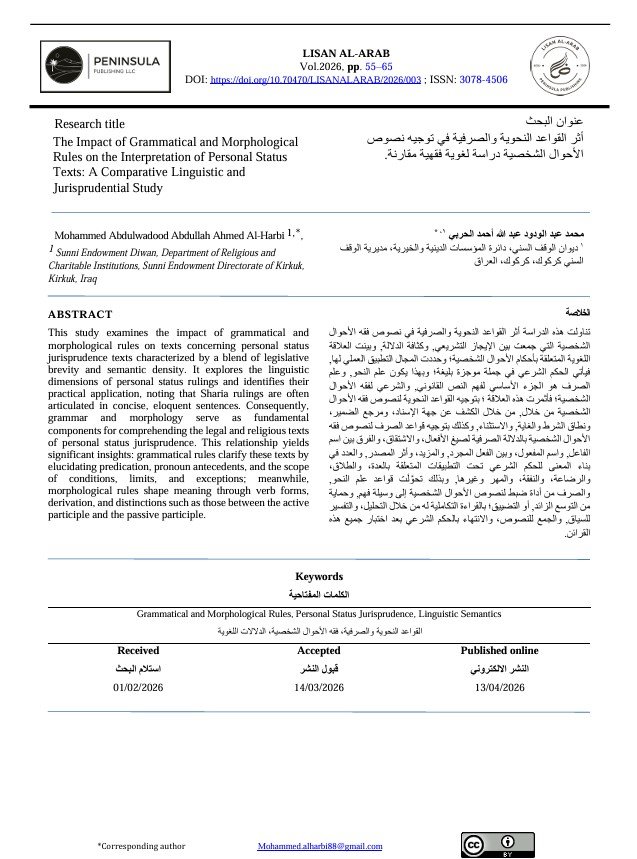
The Impact of Grammatical and Morphological Rules on the Interpretation of Personal Status Texts: A Comparative Linguistic and Jurisprudential Study
Article Sidebar
Main Article Content
Abstract
This study examines the impact of grammatical and morphological rules on texts concerning personal status jurisprudence texts characterized by a blend of legislative brevity and semantic density. It explores the linguistic dimensions of personal status rulings and identifies their practical application, noting that Sharia rulings are often articulated in concise, eloquent sentences. Consequently, grammar and morphology serve as fundamental components for comprehending the legal and religious texts of personal status jurisprudence. This relationship yields significant insights: grammatical rules clarify these texts by elucidating predication, pronoun antecedents, and the scope of conditions, limits, and exceptions; meanwhile, morphological rules shape meaning through verb forms, derivation, and distinctions such as those between the active participle and the passive participle
Article Details

This work is licensed under a Creative Commons Attribution 4.0 International License.