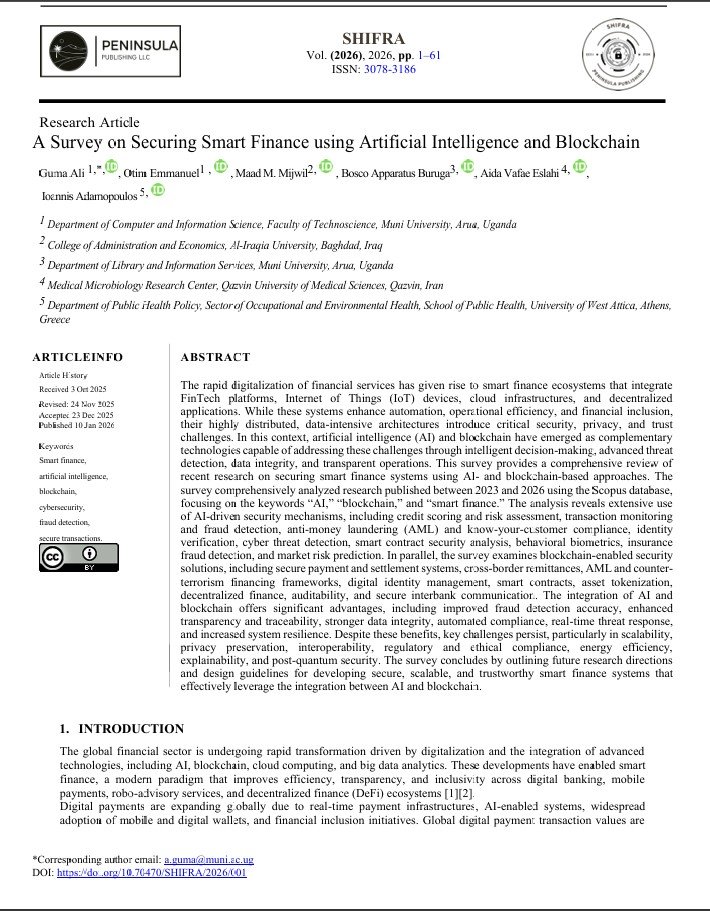
A Survey on Securing Smart Finance using Artificial Intelligence and Blockchain
Article Sidebar
Main Article Content
Abstract
The rapid digitalization of financial services has given rise to smart finance ecosystems that integrate FinTech platforms, Internet of Things (IoT) devices, cloud infrastructures, and decentralized applications. While these systems enhance automation, operational efficiency, and financial inclusion, their highly distributed, data-intensive architectures introduce critical security, privacy, and trust challenges. In this context, artificial intelligence (AI) and blockchain have emerged as complementary technologies capable of addressing these challenges through intelligent decision-making, advanced threat detection, data integrity, and transparent operations. This survey provides a comprehensive review of recent research on securing smart finance systems using AI- and blockchain-based approaches. The survey comprehensively analyzed research published between 2023 and 2026 using the Scopus database, focusing on the keywords “AI,” “blockchain,” and “smart finance.” The analysis reveals extensive use of AI-driven security mechanisms, including credit scoring and risk assessment, transaction monitoring and fraud detection, anti-money laundering (AML) and know-your-customer compliance, identity verification, cyber threat detection, smart contract security analysis, behavioral biometrics, insurance fraud detection, and market risk prediction. In parallel, the survey examines blockchain-enabled security solutions, including secure payment and settlement systems, cross-border remittances, AML and counter-terrorism financing frameworks, digital identity management, smart contracts, asset tokenization, decentralized finance, auditability, and secure interbank communication. The integration of AI and blockchain offers significant advantages, including improved fraud detection accuracy, enhanced transparency and traceability, stronger data integrity, automated compliance, real-time threat response, and increased system resilience. Despite these benefits, key challenges persist, particularly in scalability, privacy preservation, interoperability, regulatory and ethical compliance, energy efficiency, explainability, and post-quantum security. The survey concludes by outlining future research directions and design guidelines for developing secure, scalable, and trustworthy smart finance systems that effectively leverage the integration between AI and blockchain.
Article Details

This work is licensed under a Creative Commons Attribution 4.0 International License.